Nov 16, 2023
By Silvia Milanova
Sustainable Product Packaging - Updates and Alternatives
Even for the most eco conscious person, plastic continues to be a problem that won’t go away. You may try to avoid plastic as much as possible, but it is hard to avoid 100% of the time. It still sneaks its way in, usually in the form of packaging—power bar covers, meat containers and seals, store-bought bread bags, pill bottles and wraps, mailing peanuts, air bags and toxic tape—plastic packaging is everywhere and the list is endless.
The Overall Plastic Problem
Plastic production picked up after World War II and it skyrocketed in the 1950s and 1960s. Sadly, it hasn’t slowed down since. The global plastic market was valued at 712 billion U.S. dollars in 2023 and it is expected to continue to grow over the next decade, according to the Statista Research Department.
In addition, a separate sector, the global flexible packaging market, was estimated at USD 261.04 billion in 2022 and is expected to expand at a compound annual growth rate (CAGR) of 4.7% from 2023 to 2030, to reach USD 373.34 billion, according to the market research company, Grand View Research.
The reasons why plastic production and demand are continually growing is not a mystery. Plastic is convenient! It helps keep products fresher for longer, it has a strong resistance to moisture, dust, oxygen, UV light and heat; it’s also cheap to make. In those categories, nothing will quite compare to or beat plastic, which is why it’s extremely difficult to decrease its demand. However, unlike hard plastics, flexible plastic packaging lacks a circular solution—which aims to reduce waste, recycle more, and promote a sustainable use of natural resources—because flexible plastic is often made by blending several materials, it could get contaminated by food, and is too lightweight for separation and recycling. This creates a challenge for recycling programs as well as for sectors that use this type of packaging readily.
The key industries which are driving the growth for flexible packaging are the food and beverage industry, the pharmaceutical industry, and the personal care and cosmetics industry. These industries are continually demanding low-cost, convenient, shelf appealing, and lightweight packaging for their products.
Another, more specific, factor that has contributed to the growing demand for plastic packaging is the increase in online food delivery services, especially during the COVID-19 Pandemic. The online food services delivery market is projected to reach a valuation of $41.94 billion in 2023 and to continue growing at 10% each year until 2033. Even before COVID, the restaurant industry was a major contributor to single-use plastic items, such as utensils, cups, containers and straws. But during 2020, when restaurants were forced to only provide take-out meals, the problem was exasperated.
As of 2019, the world produced more than 450 million tons of plastic every year.The plastic system is expected to double plastic pollution by 2030, with oceans being the most affected (leaking more than nine million metric tons per year), according to a 2019 report from the World Wildlife Fund. We are producing plastic waste faster than we can manage it.
Possible Solutions
Sustainable packaging is no longer just a concept. For consumers worldwide, but especially those in Europe and North America, sustainable packaging is important and they are willing to pay more for it. In their 2020 Global Buying Green Report, Trivium Packaging identified that 47% of consumers won’t buy products in packaging that is harmful to the environment. And 74% of consumers are willing to pay more for sustainable packaging. Governments, such as Canada, are also jumping on board and recognizing innovators of sustainable plastic packaging through programs like the Plastics challenge: Sustainable alternatives to plastic packaging.
So, it’s clear that the demand for eco-friendly packaging is there. Now, what can be done to meet this demand, appeal to consumers’ needs and lessen the overall production of plastic, specifically, plastic packaging?
Here are some unique innovations and alternatives to plastic packaging that are currently available for use:
Wood-Based Packaging Materials
Glassine (from JBM Packaging) – Glassine is a pulp-based material. Because of its unique features, glassine has been mistaken for other substrates, such as wax and parchment paper, and even plastic! But glassine is actually paper that is smooth, glossy and transparent—allowing what’s inside or behind the paper to show through. Glassine is made from hardwood trees, primarily varieties of aspen, oak, birch, and gum. The best part is that it’s resistant to the effects of grease, water, air, and moisture. It is FDA-approved for direct contact with food and it can be safely sterilized (an important emergence from the COVID-19 Pandemic). Since it is made from wood pulp, glassine is free from coatings, dyes and acids, and is fully recyclable and biodegradable. Glassine has a higher density and caliper, which allow for greater bursting and tensile strength, folding endurance, and stiffness than papers of similar weight. Since it is so hardwearing, it is a robust choice for enclosures and packaging (envelopes, pouches, bags and wrappers), for items such as food, soaps and sterilized surgical needles. The versatile use of this paper material makes it ideal for numerous industries that utilize one-time packaging.
Residual and Waste Wood (from Repaq) – a plastic-free, printed film packaging, which is 100% biologically recyclable. This means that the material is metabolized in natural bioactive environments, both on land and in the sea, and turns into H2O, CO2 and biomass. The raw material for Repaq (cellulose and paper) comes from residual and waste wood from PEFC* and FSC-certified forestry, GMO-free and fast-growing plants. The material composts completely within a maximum of 180 days, and is toxin-free and safe for the environment, animals and humans. Repaq packaging is certified "plastic free", which means it contains NO microplastics or nanoplastics. Repaq is available in roll form as printed mono film, 2-layer film and 3-layer film. For bags, Repaq offers stand-up pouches, flat bags, gusseted bags, stabilobags, block bottom bags and bottom gusseted bags; all good options for food packaging.
*PEFC is the Programme for the Endorsement of Forest Certification, an international non-profit, non-governmental organization based in Switzerland that is dedicated to promoting sustainable forest management through independent third-party certification.
Plant-Based Packaging Materials (Bio-Plastics)
If you have a business that doesn’t want to use plastic packaging OR packaging made from trees (for many reasons we have outlined before), here are options for packaging materials made from renewable resources, such as plants.
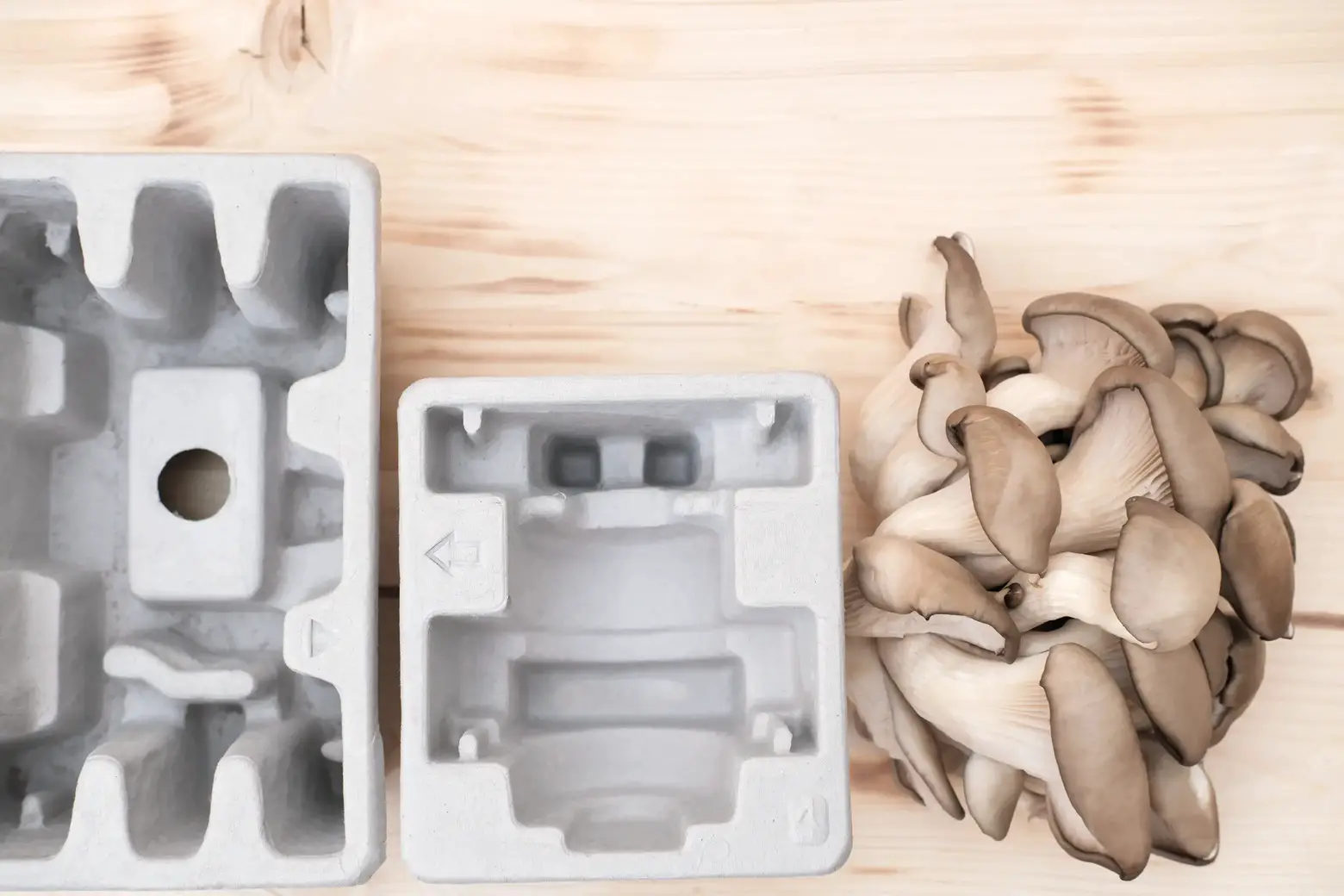
Mushroom® Packaging – high-performing, sustainable packaging solutions grown from mycelium, or the “roots” of mushrooms. Called MycoComposite™, this material is made with two simple ingredients, mycelium and hemp hurd. This makes the packaging a great regenerative alternative for the plastic foams used in protective packaging. Mushroom® Packaging is grown to shape in only 7 days, custom molded at a fraction of the cost of foam, flame resistant and naturally water resistant, which makes it suitable for thermal applications and shipping with ice packs that are subject to melting. Unlike plastics, this packaging is biodegradable and fully home-compostable in 45 days, which adds nutrients to the soil.
Seaweed Packaging (from Notpla) – this is a family of regenerative packaging materials, made from seaweed and plants. Options for packaging include solutions for many everyday applications, including takeout food containers, hard cosmetics shells (for creams, etc.), pipettes for oils, seaweed-paper, dissolving pods and films. Some of these products are edible, some compostable, and some dissolve in water.
Fish Waste Plastic Film and Packaging (from MarinaTex®; currently still in the final stages of development) – this material is made using 100% organic materials sourced from the sea. This includes agar from red algae and proteins from fish processing waste from the fishing industry (such as fish skins and scales). Thankfully, the material does not smell! The end result, which is a transparent film, can be used in a variety of applications where plastic would usually prevail. This includes packaging, plastic bags and wraps. The organic raw material can be consumed, it will degrade in a soil environment in under 6 weeks, and it does not leach harmful chemicals or cause harm to wildlife or humans.
Cassava Root Packaging (from Evoware and Cassava Bags Australia) – bags and mailers made from a bio-based polymer compound produced from cassava or corn starch, as well as vegetable oil derivatives. Once turned into starch, cassava can be plasticized using vegetable oils without any polluting chemicals, Polylactic acid (PLA), or polyolefins. The bags completely decompose into carbon dioxide, water, and biomass, which are all naturally occurring substances.
Banana Leaves Packaging (from Arekapak) – a sustainable, food-safe packaging design made from already fallen areca palm leaves. The containers are suitable for service and take-out packaging, for example, for sushi. The production of the material requires no land clearing, no energy, little water and no additives. When the fallen leaves are collected and dried in the dun, the untreated raw material is finally shaped by a hydraulic pressing process. The end-product is naturally resistant to liquids for several hours without the need for a coating, is suitable for ovens and microwaves, and is resistant to refrigeration and deep-freezing. Since the material is natural and uncoated/untreated, it is approved for disposal in a household’s organic waste bin or with regular household waste.
Mixed Materials Packaging (Fully Compostable)
Did you know that some fossil-based polymers are also compostable? The European Bioplastics association states that a material is defined as a bioplastic if it is either biobased, biodegradable, or features both properties. Therefore, certain blends of biomass and fossil-based polymers are compostable in either home and/or industrial settings.
Bio and Fossil-Based Plastic Bags (from TIPA®) – a great alternative to conventional plastic bags and films, this material contains no toxic residue, microplastics, or other pollutants. TIPA® packaging is made from proprietary blends of fully compostable polymers that are both bio-based and fossil-based. The material is between 20-80% bio-based, and the remaining percentage is made of fully compostable fossil-based polymers. The goal of TIPA® is to have flexible packaging that has the “same end-of-life as organic matter while maintaining the qualities of conventional plastics that consumers and brands have come to rely on, like durability, transparency, barrier, sealability, printability, and shelf-life”. Since the packaging is manufactured with the same machinery as conventional plastics, this production can be scaled globally. The packaging material is ideal for fresh produce, dry food, baked goods, clothing bags for shipping, pre-made packaging for food items (such as grapes), and as wraps for items such as bars and bags for items such as pasta and cereal.
Biopolymers/Wood/Natural Clay Packaging (from Sulapac®) – a beautiful alternative to plastic for even the priciest brands, Sulapac® materials can replace conventional plastic in many instances, such as cosmetic packaging, cutlery, straws, kitchenware, takeaway packaging, pill bottles and many others. The main components for the material are biodegradable biopolymers, sustainable fillers like side stream wood, and natural clay minerals. All of the raw materials are sustainably sourced and approved for food contact. For example, the wood comes from the wood industry’s processing side streams. All of the materials also contain 20–100% recycled content. This material is safe for people and the planet: it leaves no persistent microplastics or toxics behind at any stage of its lifecycle. All of the raw materials used for Sulapac® can be both mechanically and chemically recycled, and are food contact compliant and industrially compostable. This alternative material can be processed by various manufacturing technologies and machinery that currently exist. This allows the material to be adopted and scaled quickly.
Bio-based plastics no longer mean just corn and wheat. Current innovations are smart, durable and beautiful. With companies striving to make these solutions scalable globally and available to a variety of industries and companies, let’s hope that the future contains a lot less plastic and a much cleaner and healthier ecosystem.